I remember standing at Rossio Station in Lisbon, watching a couple argue over their rental car pickup time while I held a €15 train ticket to Porto in my hand. They’d just spent twenty minutes on the phone with the rental company about insurance add-ons and toll transponders. I boarded my train. They were still arguing when I left. Here’s what nobody tells you about planning a Portugal 8-10 days itinerary: the car isn’t the flex you think it is—it’s often the thing that ruins the rhythm of your trip. Can you really explore Portugal without renting a car, using only buses and trains?
The short answer is yes, and honestly, it’s better that way. I’ve done Portugal both ways—once with a rental car navigating Porto’s nightmare hills at 7am (never again), and once relying entirely on public transport, and the latter felt more like travel and less like a logistics operation. The train from Lisbon to Porto costs less than a tank of gas, takes about three hours, and doesn’t require you to decode Portuguese toll systems or find parking in medieval alleyways designed for donkeys, not Fiats.
| Route/Connection | Transport Type | Duration | Approximate Cost | Booking Platform |
|---|---|---|---|---|
| Lisbon to Sintra | Train (Linha de Sintra) | 40 minutes | €2.30 one-way | At station or Viva Viagem card |
| Lisbon to Porto | Train (Alfa Pendular or Intercidades) | 2h 40min – 3h 15min | €15-30 (advance booking) | CP – Comboios de Portugal |
| Porto to Douro Valley (Peso da Régua) | Train (Linha do Douro) | 2 hours | €12-15 one-way | CP or at station |
| Lisbon to Óbidos | Bus (Rede Expressos) | 1 hour | €8-10 | Rede Expressos website |
| Porto to Nazaré | Bus (Rede Expressos) | 2h 30min | €12-15 | Rede Expressos website |
| Within Lisbon | Metro/Tram/Bus | Varies | €1.50 per trip (Viva Viagem card) | Vending machines at stations |
| Within Porto | Metro/Bus | Varies | €1.20-2 per trip (Andante card) | Vending machines at stations |
Let me be honest about something most travel guides gloss over: the split between Lisbon and Porto is the most contentious decision you’ll make. Online forums are full of people saying “Porto felt more authentically Portuguese” or “I wish I’d spent more time in Porto and less in Lisbon.” And you know what? They’re not wrong. Porto does have this gritty, lived-in charm that Lisbon—beautiful as it is—sometimes lacks beneath all the tourism gloss. But here’s the thing: you’re a first-timer with 8-10 days, and Lisbon is the better base for day trips. Sintra, Óbidos, even Nazaré if you push it—all radiate from Lisbon. Porto’s day trip game is basically just the Douro Valley (which is spectacular, don’t get me wrong) and maybe Guimarães if you’re really into medieval history.
So here’s the framework that actually works: three full days in Lisbon, one day for Sintra, one flexible day for either Óbidos or beach time, then train up to Porto for two to three days with one Douro Valley day trip. That’s nine days right there, not counting arrival and departure. And the rhythm—this is important—feels human. You’re not constantly packing and unpacking. You’re not waking up at 6am to “maximize” your day (which really just means being exhausted by 3pm). You’re traveling like a person, not a checklist.

The Lisbon leg should start slow. I don’t care what your type-A travel spreadsheet says—if you land in the morning after an overnight flight, your first afternoon should be wandering Alfama, eating pastéis de nata, and riding Tram 28 without worrying about hitting all the miradouros. Day two is when you attack the city properly: Belém in the morning (get to Jerónimos Monastery before 10am or you’ll be in line with every river cruise passenger in the North Atlantic), LX Factory or Time Out Market for lunch, then Bairro Alto in the evening. The Viva Viagem card you bought at the airport makes all this stupid easy—load it with €15 and you won’t think about transport for days.
Day three, you’re going to Sintra. Book the first train out—seriously, the 8:30am if you can drag yourself out of bed, because this is the move that separates people who saw Sintra from people who were crushed by Sintra’s tourist hordes. The train from Rossio Station takes 40 minutes and dumps you right in town. From there, you’ve got choices: either commit to seeing Pena Palace and the Moorish Castle (which means buying tickets online in advance because same-day queues are brutal), or skip the famous stuff entirely and hike the trails around Monserrate Palace, which is criminally underrated and usually empty. Most people do the former. I preferred the latter. Either way, you’re back in Lisbon by evening with sore feet and a camera full of forest shots that look like they were ripped from a Tolkien novel.
Now, this is where opinions split hard. That fourth day? Some people tell you to stay in Lisbon and see what you missed. Others say take the bus to Óbidos, that postcard-perfect medieval village with the cherry liqueur shots and the defensive walls you can walk. I’d argue for Óbidos if you’re even slightly interested in small-town Portugal, because it’s only an hour by bus and it’s one of those places that feels impossibly quaint without feeling fake. Plus the Rede Expressos buses are comfortable and have WiFi, which—let’s be real—matters when you’re trying to figure out where you’re having dinner.
But. (And this is the contrarian take.) If you showed up to Portugal in March or October and the weather is gorgeous, skip Óbidos and take the train to Cascais or Carcavelos beach instead. Nobody regrets an afternoon on the Portuguese coast. The train runs every 20 minutes from Cais do Sodré, costs €2.30, and delivers you to a string of Atlantic beaches where you can eat grilled sardines and watch kite surfers. That’s the kind of flexibility public transport gives you—spontaneity without having to worry about gas prices or parking fees.
Day five or six, you’re Porto-bound. The train is the only move here unless you’ve got some weird obsession with FlixBus. The Alfa Pendular high-speed train does Lisbon to Porto in under three hours, costs between €25-30 if you book a few days ahead (don’t book same-day unless you enjoy paying €45 for no reason), and drops you at Campanhã Station on Porto’s east side. From there, it’s either a metro ride or a short Uber into the Ribeira district, which is where you probably booked your accommodation because everyone does.
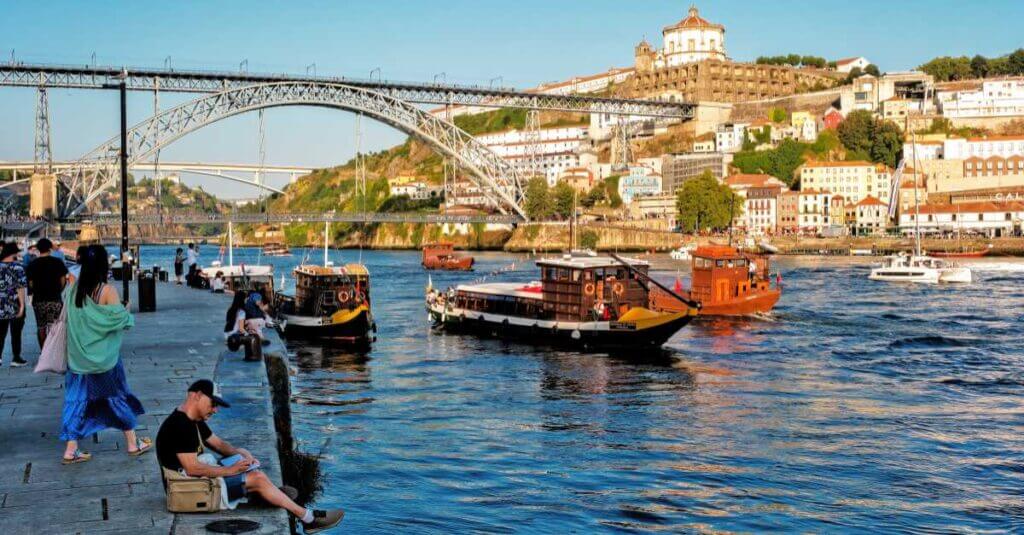
Porto is smaller, hillier, and—I’m just going to say it—more interesting than Lisbon for the kind of person who travels to experience a place rather than photograph it. The Ribeira riverfront is stunning in that Instagram-friendly way, sure, but it’s also where actual Portuguese families eat lunch and where rivermen used to unload port wine barrels before the tourist boom. Walk uphill from there and you’re in neighborhoods most visitors skip entirely: Miragaia, Cedofeita, the gardens around the Crystal Palace. These areas don’t make the highlight reels but they’re where Porto actually lives.
Your first Porto day should be a wander. Cross the Dom Luís I Bridge on the upper deck (you’ll see why everyone photographs it), poke around the port wine lodges in Vila Nova de Gaia (Taylor’s and Graham’s do good tours if you’re into that, but honestly the smaller places are more fun), and then get lost in the backstreets north of Avenida dos Aliados. If you’re moving around within the city, the Andante metro card works the same way Lisbon’s Viva card does—load it once, tap as you go. Ubers and Bolts here are absurdly cheap by American standards, like €4-6 for trips that would cost $20 in any US city, so don’t stress about the metro if you’re tired and it’s 11pm.
Day two in Porto is Douro Valley day, and this is non-negotiable. The train from São Bento Station follows the Douro River east through some of the most photogenic wine country in Europe—terraced vineyards, whitewashed quintas, river bends that look Photoshopped but aren’t. The Linha do Douro train to Peso da Régua takes about two hours, costs maybe €12, and doesn’t require advance booking. You can get off at Régua, eat lunch, walk around the riverfront, maybe tour a wine estate if you arranged it (Quinta do Vallado is close to town), then catch a train back in the late afternoon. Some people spring for those expensive river cruise day tours from Porto. I think they’re a waste—you see the same views from the train for a tenth of the price, and you’re not trapped on a boat with 80 retirees from Ohio.
If you’ve got a third day in Porto (and you should), this is your flex day. Maybe you day-trip to Guimarães, the “birthplace of Portugal” with its medieval castle and historic center. Maybe you take the bus to Aveiro, that quirky canal town people call the “Venice of Portugal” (it’s not, but it’s charming in its own way). Or maybe—and this is what I’d do—you stay in Porto, sleep in, eat a long lunch at a tasca in the Bolhão Market area, and just exist in the city without an agenda. Not every day needs to be optimized. Sometimes the best travel days are the ones where you sit in a café for two hours watching people and realize you’re in no rush to be anywhere else.
Here’s what the classic Portugal 8-10 days itinerary misses: the transition days matter as much as the destination days. That train ride from Lisbon to Porto? It’s not dead time—it’s three hours of Portuguese countryside sliding past your window, time to read or journal or just decompress. Same with the Sintra train, the Douro line, any of it. When you drive, you’re focused on the road, the GPS, the gas station, the tolls. When you’re on public transport, you’re present. You notice things. The elderly woman across from you knitting. The university students arguing about football. The way the light changes when you get north of Coimbra.
The money argument seals it. A rental car for eight days in Portugal runs €200-400 depending on season and company, plus another €80-120 for tolls, €150-200 for gas, and whatever parking costs you rack up (Porto parking garages charge €15-20 per day in the center). That’s €450-740 total, minimum. The trains and buses for the exact itinerary I described? Maybe €120-150 total. Even if you Uber around the cities liberally, you’re still under €250. The math isn’t close.
And look, I get the appeal of the car. Freedom! Flexibility! Stopping at random viewpoints! Except the viewpoints you actually want to stop at—the miradouros in Lisbon, the wine estates in Douro, the clifftops in Sintra—are either inaccessible by car or require driving through streets so narrow you’ll scrape your mirrors off. I watched a couple in a rented Volkswagen try to navigate the backstreets of Alfama for 20 minutes, reversing and re-angling while delivery scooters zipped past them. They looked miserable. I was on Tram 28, drinking a galão, living my best life.
The Algarve question comes up a lot in these conversations. Should you squeeze in the southern coast? With 8-10 days, no. Absolutely not. The Algarve is fantastic—cliffs and beaches and that specific golden Portuguese light—but it’s a four-hour bus ride from Lisbon each way, and it’s spread out in a way that makes it car-dependent once you’re there. If you had two weeks, sure, add four Algarve days. With 10 days, you’re just going to stress yourself out and see everything at half-speed. Save it for the next trip. Portugal isn’t going anywhere.
Also Read: Family Road Trip Portugal for Americans: 10 Hidden Towns
Same logic applies to Madeira. It’s stunning. It’s also a flight. You’ll lose an entire travel day each way, and with only 8-10 days, that’s a quarter of your trip spent in airports and planes. Madeira deserves its own week-long trip, ideally paired with the Azores if you’re going full Portuguese islands mode. But for a first-timer hitting the mainland cities, it’s a distraction.
The rhythm I’m describing—three Lisbon days plus day trips, then three Porto days with Douro Valley—leaves you with one or two buffer days depending on your exact schedule. Use them wisely. If you’re someone who needs downtime, build in a rest day in Lisbon or Porto where you don’t have an agenda. If you’re high-energy, add Óbidos and maybe even Nazaré (though Nazaré from Porto is easier than from Lisbon logistically). If you’re obsessed with food, build in a full day for eating your way through Time Out Market, O Buraco, and every pastelaria in Belém. The framework is flexible. That’s the point.
One more thing that doesn’t get mentioned enough: Portuguese public transport is legitimately good. It’s clean, it’s punctual (mostly), and it’s designed for normal humans, not just tourists. The trains have WiFi, power outlets, and comfortable seats. The buses have bathrooms on long-haul routes (though FlixBus doesn’t always, so check before booking). The metro systems in both cities are straightforward—if you can navigate the NYC subway or London Tube, you can handle Lisbon and Porto with your eyes closed. And when something goes wrong—a delayed train, a missed connection—you adapt. That’s travel. Nobody’s perfect itinerary survives contact with reality.
The best trips I’ve ever taken have been the ones where I threw out the spreadsheet halfway through and just followed what felt right. Maybe that’s beach time in Cascais. Maybe that’s a second Douro Valley trip because the first one was that good. Maybe that’s staying an extra day in Porto because you met people at a hostel and they’re doing a free walking tour you want to join. Public transport gives you that flexibility. A rental car locks you into a schedule—pickup times, dropoff times, places you’ve already committed to because “well, we drove all this way.”
Also Read: Budget-Friendly Flights From USA to Portugal: 7 Smart Hacks
What’s been your experience with planning a Portugal 8-10 days itinerary using public transport? Did you stick to the Lisbon-Porto corridor or try to add the Algarve? Let me know in the comments.